
Make Good is a podcast from Heath Ceramics, co-hosted by Cathy Bailey—Heath’s co-owner and brand steward—and Simone Silverstein, who has worked with Cathy for over 20 years to develop Heath’s brand and tell its story.
Small disclaimer: We’re not in a sound studio. We have a dog named Ponch wandering around.
The conversation below has been edited for length and clarity.
“We need to make money to keep doing the work—to pay for it.
That's the point of profit.”
— Cathy Bailey
Cathy: For the Long Haul is one of our objectives. It’s actually objective number one. We have nine objectives to guide Heath as it becomes a Purpose Trust. We need these ideas to help guide everyone who works at Heath to ensure it stays true to its purpose.
Simone: Just to remind you: the purpose is to keep artisanal craft alive through products and experiences rooted in designing and making. That’s the largest umbrella purpose for Heath. And under that are nine objectives that help guide decisions day to day.
We like to start these episodes with where we’re recording.
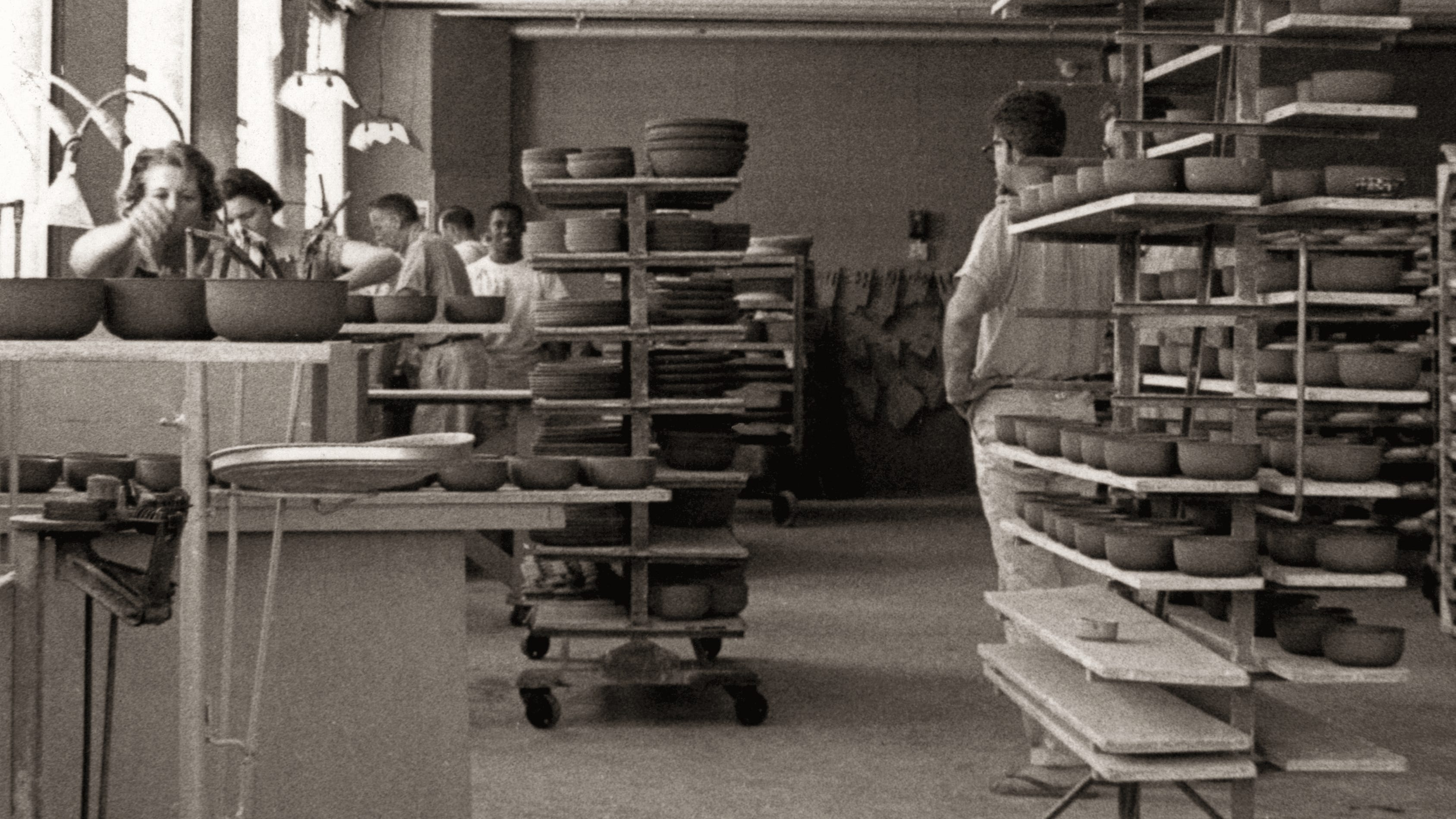
Cathy: We’re in Sausalito at the 1959 Heath Ceramics building. This place has already been with us for the long haul, long before I ever got here. There’s something cool about that—it makes you want to honor it and keep it going. If someone else could keep it going for this long, can we continue to make a plan to keep it going for at least that long, and hopefully double or triple that?
Simone: You’ve brought up this idea before—as change happens, asking the question: what do you lose?
Cathy: When we make a change, we try to really think about that. What are we really improving by making that change? Are we really making anything better if we tore down this building and built a new one? Some things would be better—we might have an HVAC system. But what would be the price we would pay? It would put the company on a different trajectory. What would we really gain?
Simone: Not only would we lose the money, but we would also lose the character of this place.
Cathy: You’d have to put a lot more work into getting people to feel what the history is and what was important about it. Walking through the building, a lot of it is self-evident—there are layers and layers of history right here. You’d have to articulate that in another way if it were gone.
Simone: When we talk about being in it for the long haul, I wonder, isn’t every business in it for the long haul?
Cathy: A lot of people starting businesses are not in it for the long haul, because they’re immediately thinking about how to get out. What’s their exit strategy?
That’s quite common—their goal is usually financial, foremost. They’re selling at a certain part of their trajectory, and then things kind of go downhill because it was a good idea or part of a trend. It’s just: how do we make a quick investment go well?
Simone: And Heath is not like what we just described.
Cathy: It’s kind of what we’re pushing against. There are people who can do that, but it shouldn’t be seen as the only or right way. It should be okay—and celebrated—to have different reasons for having a business.
Simone: If Heath’s reason for being in it for the long haul isn’t just to keep the doors open, is there a greater reason?
Cathy: I really believe there’s an importance in what we do and how we do it. We believe that craft and the tangible making of things play an important role in our culture.
Heath has played an important role historically in doing that. By staying in it for the long haul, we’re keeping craft as a part of our culture and community. Those are the reasons that give it purpose. We’re trying to push against the most obvious answer—this will make us more money—and make sure that isn’t sending us on a track that just feels good at the moment. How is this brand going to continue to stay relevant? How is it not going to feel like it was following a trend?
Simone: So it’s not just to endure as a business—it’s to shape a culture.
Cathy: Yes. To be a part of culture in a positive way. The craft, the objects, the longevity, the materials, the artistic experimentation, the human hand—all those things feel really important. They’re integral to our business. We want to continue them.
Simone: I often think: if Heath didn’t do it, who would?
Cathy: There are individual artists and designers with that spirit taking the torch. But I usually see that falter at scale. That’s what we’re trying to do—at scale, see if we can keep those things alive.
Simone: It’s like driving a stick shift, where the clutch and the gas have to find just that spot where it pushes you forward.
Cathy: Great analogy. Because after doing Heath for a while, you just start to be instinctual about what is real compromise and what you can update—and what’s really going to stall you out.
Simone: Back to this idea of shaping culture. Individual makers have a similar plight to keep craft alive. What you’re saying is that Heath would be scaling it. Like Edith, she wanted to take hand-thrown pieces and make them more accessible to more people.
Cathy: She did, and that’s what her mission was. There were these boundaries around the craft, the character, and the materials that she thought were important. Today, those things are still important, and there are some new ones.
Simone: What role does a company like Heath play in society, in shaping culture, by being around for the long haul?
Cathy: There’s actually the craft and keeping it part of your community and culture—you have people who can have jobs in a craft-based business alongside people who never thought they’d go into that kind of business, because they have expertise in marketing or engineering or data. You have this really wonderful ecosystem where everybody sees through a different lens.
We also feel like we want to be an example that capitalism doesn’t have to go off the rails. Not every business has to become a public company where the main objective is profit for shareholders. We can be happy with a smaller-scale business that has strong values, a purpose, and good finances.
I want more people to see that there’s not only one way. It just feels mysterious and bizarre to some people that we didn’t have massive outside investment and grew at a slower pace. It doesn’t feel like something people are considering as they’re charting a business today.
Simone: When a business like Heath is in it for the long haul and thinks regeneratively, what we’re actively doing is not defaulting to cheaper, easier, faster.
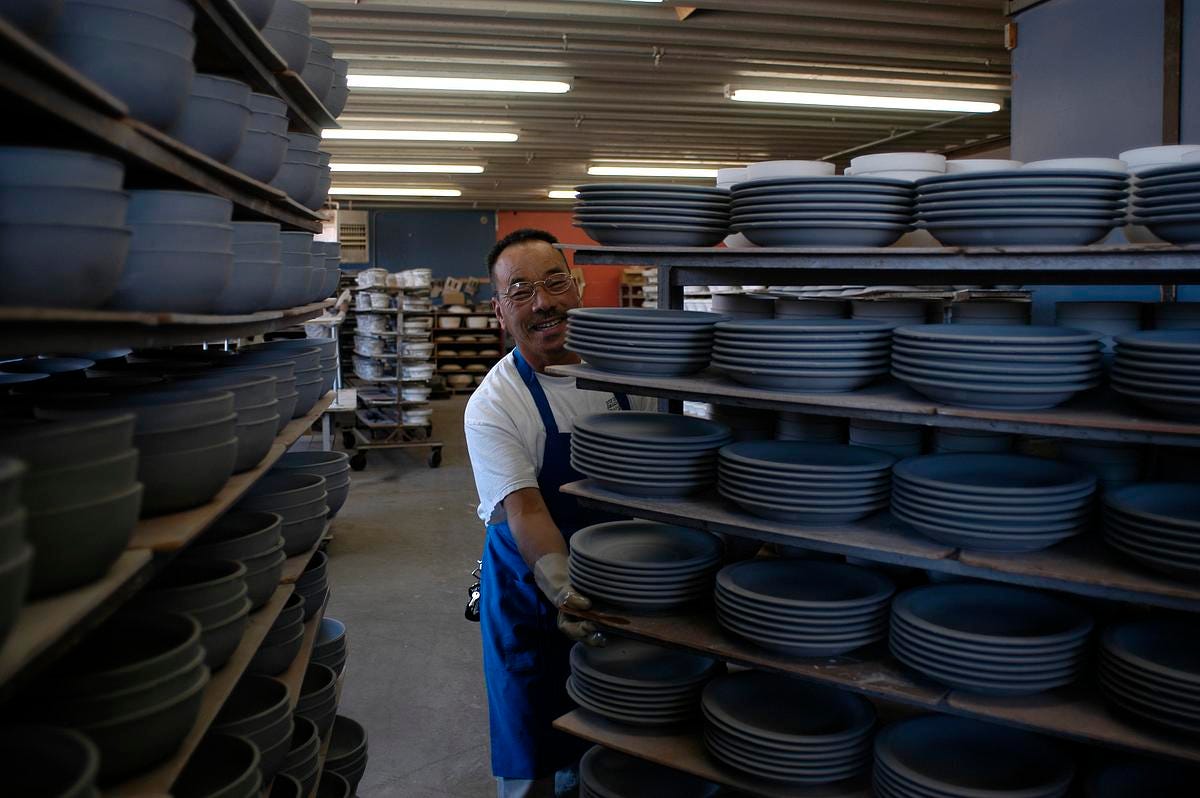
Cathy: That’s not the primary goal, and I don’t think it would keep us in it for the long haul if it were. Take our glazes—we have several different glaze bases. Some finishes are more matte, some more glossy, some have pinhole textures, some colors change as they get thicker and thinner. It’s complicated. But it’s interesting, and no one else does it. It’s completely inefficient, and that’s the point.
Simone: How does that tie back to being in it for the long haul?
Cathy: Let’s say we simplified. I think you’re more likely to be one of those companies that’s hot for a minute and then not, because you don’t have the breadth. There’s some real truth in that.
Simone: One of the reasons the Purpose Trust is in place is so there’s a company many, many years down the line.
Cathy: Not just a company—a company with the same intent. If we had sold instead, there’s a pretty good chance it would stay in business. The brand is strong and has significant growth potential. But it wouldn’t be the Heath we know. It would transform into something very different. The purpose of the trust is more about keeping it aligned—keeping the North Star where it’s been set for the past almost 80 years. If you sold the company, you’d just have no control over that.
Simone: If you look at how the company started, and what the direction it was pointed in, the goal always has and always ought to be to generally go in that direction with changes as the world changes. But none of these hard rights and hard lefts.
Cathy: The world of manufacturing has changed so much. I think Edith and Brian really wanted this democratic product, and that wasn’t a crazy idea. Heath was always expensive, but everything was. As the world has amped up in making our things in more efficient ways and in places of increasingly cheap labor, the idea of being democratic isn’t really with us anymore. We can’t compete with IKEA or Walmart-level plates.
It’s something we decided—if that was more important, we would have to take a real left turn, and we couldn’t manufacture here. We decided manufacturing here was more important. It’s not going to be for everybody, but we’ll be able to keep our other values aligned with how they were set out.
Simone: Do you think Edith and Brian would have kept manufacturing here?
Cathy: Hard to say—I didn’t work with them personally, but they had a strong connection to this plant. Everyone who thought about acquiring Heath and advised us said domestic manufacturing wasn’t the right strategy, but we did it anyway. It wasn’t what everybody else was doing, so it differentiates us, makes us more unique.
Simone: When a business like Heath was started, what was it like for them in 1947? How did they think about business?
Cathy: It might be interesting to explain the shift in how the business used to work. A company called Gustin handled all of Heath’s marketing, sales, and distribution—a wholesale model through department stores, design shops, and restaurants. Heath was able to focus much more on what their expertise was: making. But when we acquired the business in 2003, the Gustins had retired, the company was gone, and Heath had been declining from a sales perspective since the 80s. That just wasn’t how they had built the foundation of Heath.
Simone: So now Heath handles its own distribution?
Cathy: Yes. We thought the best way to make the brand we envision is to control it all—to decide exactly where the brand appears and how it’s perceived. It means more consistency. What struck me when we first arrived was how self-sufficient the operation was—they had a machine shop, could fix their own equipment—but that self-sufficiency only applied to the making side, not the business side.
Simone: And you don’t have to worry about the Gustins retiring. It’s all in-house.
Cathy: What struck me when we first stepped into Heath was how self-sufficient the operation was—they had a machine shop, could fix their own equipment—but that self-sufficiency only applied to the making side, not the business side.
Simone: Profit is an important part of this. Heath isn’t so altruistic that making money doesn’t matter. We need to make money to keep doing the work.
Cathy: Absolutely. We need profit to keep doing the work. It’s profit to a point—enough to pay people fairly, support the purpose, and sustain the business. Good capitalism, I think. There’s a lot of room for businesses that aren’t chasing extreme financial upside, just enough to support what they’re doing.
Simone: Not too big, not too small.
“The goal is not just to endure as a business—it's to shape a culture.”
— Simone Silverstein
Thanks for reading, listening, and for being here with us.
Next episode: Two at the Top—balancing creativity and operations, and why that’s so important as Heath moves into the future. Surprise! We’re joined by three special guests: Robin, Allison, and Megan.