
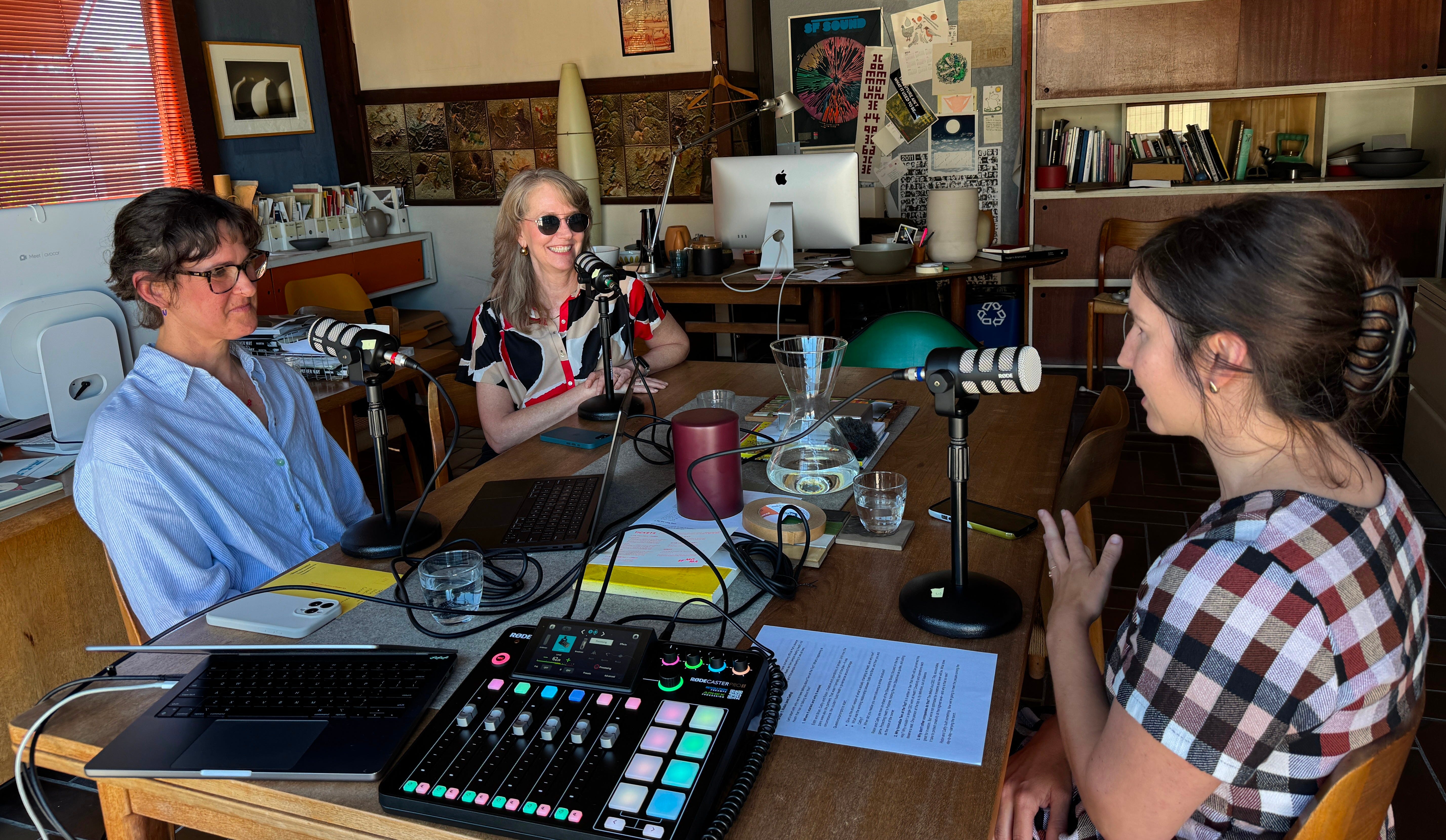
Make Good is a podcast from Heath Ceramics, co-hosted by Cathy Bailey—Heath’s co-owner and brand steward—and Simone Silverstein, who has worked with Cathy for over 20 years to develop Heath’s brand and tell its story.
Small disclaimer: We’re not in a sound studio. We have a dog named Ponch wandering around.
The conversation below has been edited for length and clarity.
Simone: Today’s episode is called Two at the Top. We just made something official that’s always been true at Heath—but wasn’t formalized. There are now two people officially leading Heath. The people who made that decision, and the people inheriting it, are all here.
Cathy: Robin is here with us. Robin, give us some background on how you got to co-chair.
Robin: We’ve been co-chairs together for the last 6+ months. Before that, my title was CEO, and before that, Managing Director. Cathy was the Creative Director. It’s been a journey of titles.
Simone: What role do the two of you play? And what is a co-chair?
Cathy: We’re transitioning to co-chairmen of a stewardship board. We’ve been working together with our different strengths for so many years leading Heath, and we’re carrying that forward in this chairmanship role.
Simone: What’s changing at Heath that prompted this? You just sent out a letter this past February about some of those changes.
“Edith oversaw creative and design, Brian handled manufacturing and operations. Cathy and I took on similar roles. But at the top level—vision, direction, brand—those were always shared. – Robin Petravic
Robin: We’re transitioning to a Purpose Trust—the company will be owned by its Purpose, a legal entity, rather than by individuals with financial interests.
Being co-chairs of a board means stewarding Heath’s legacy by a set of guidelines. The board provides oversight: Is the company following the purpose and objectives laid out in the trust? It’s a big change—we’re now focused on stewardship, not day-to-day operations. We have far fewer meetings.
Cathy: It’s very exciting, because to do it we had to think carefully about what has made this work from the very beginning.


Simone: Heath was led by Edith and Brian Heath. In 2003, the two of you refounded the business. There have always been two people at the top—that was happenstance.
Robin: Edith and Brian were married, and their partnership extended across the business—Edith oversaw creative and design, Brian handled manufacturing and operations. Cathy and I took on similar roles. Cathy focused on creative and design, and I focused on operations. But at the top level—vision, direction, brand—those were always shared decisions, brainstorms, dreams. The day-to-day, we separated out.
Cathy: There was something people liked about it. A consistency to the small family business feel. But it’s not something you’d want to have to be a qualification for future leadership. There are serious pros and cons to being married and running a business together.
Robin: The comparisons are unavoidable for employees who’ve worked under both. But as we found over the years, Two at the Top is essential—you don’t have to be a married couple, but there is something key for a creative business that makes it important.
Simone: You’ve formalized Heath being led by co-presidents going forward. You two have stepped into co-chair, leaving space for two new people. What does it mean to formalize Two at the Top?
Cathy: It seems so obvious now, but there was more than a year of struggle—who could be the CEO of Heath? The standard org chart, one person on top, felt impossible. The things that are important about how Heath works would surely fall out of balance. We couldn’t imagine a single CEO who could balance it all.
Robin: We both cared deeply about all areas of the business, even where we had specific roles. It comes from thinking holistically about a creative business. If something is going to be beautiful, it has to be made well. If a company is going to have a great brand, it has to be run well. We don’t want a beautiful facade hiding something you wouldn’t want anyone to see.
Simone: What would a single person running Heath need to embody?
Cathy: You could have someone experienced running a creative company who deeply appreciates design—but they’d still report to someone at the top, and that throws things off.
Robin: Wearing two hats is hard. You make compromises and balance tensions between creativity and operations. As owners, your house is on the line, so you wear both hats out of necessity. In a Purpose Trust, that’s no longer the case—so the structure itself has to create that balance.
Cathy: We’ve talked about how having that ‘skin in the game’ might be the key to making you care about things that might be less interesting to you. But I do feel like the idea of a Purpose Trust—stewarding something important—means anyone who’s leading it has skin in the game in a different way. Yeah, your house isn’t on the line, but you might really let down something that matters to a lot of people.
Robin: That’s the basis of why Two at the Top matters. Heath is built on creativity — design that comes from exploration and curiosity, not quantitative decisions. It’s instinct and feel. Operations and finance, if left unchecked, can crush creativity because they move faster. They’re quantitative, easy to prove, and easy to argue. Leadership has to protect that space. Otherwise, you risk losing creativity, and then you lose the whole reason why Heath is Heath.
“Heath is built on creativity—design that comes from exploration and curiosity, not quantitative decisions. Leadership has to protect that space. Otherwise, you risk losing the whole reason why Heath is Heath.”
– Robin Petravic
Simone: What is the current structure? Who’s going to be joining me in a moment? We’ve talked about this balance, we’ve talked about Two at the Top. What role do these two people play?
Cathy: Megan Wernetti has been here 13 years. I remember hiring her—she had an architecture background working in graphic design, but this amazing holistic thinking came across as she was explaining her portfolio.
Robin: Design sensibility, thinking through systems.
Cathy: Exactly. She’s held many different roles at Heath—didn’t jump straight from graphic designer to co-President. She couldn’t be more perfect for the job because she deeply understands the creative side and why you need structure where magic can happen. But she understands the business too.
Robin: Megan is co-President for Creative, and her complement is Allison Banks, co-President for Operations. Allison has been here six or seven years. She came in to lead the People team—very calm, great with hard situations, strong leadership instincts. But she also thought about the business holistically, not just her own area. She took on more and more, eventually became COO, taking on operational responsibilities that had been on my plate. She has a high bar for achievement, understands what makes Heath, Heath, and has the curiosity to really dig in.
Cathy: Allison’s thing is: if I can dig in, I can figure it out. Confidence and curiosity. Both of these leaders have that.
Robin: And Allison brought real structure to the way we approach planning, training—all of it. A structure that lets a creative company perform better while still being a creative company. That was a gift she brought almost right away.
Simone: Before we bring them in—I’ve known for a long time that this was the only way Heath could continue forward. Not because I know everything, but from watching how you two maintained a sound, whole company. It never felt possible for one person to hold both of those areas. I’m thrilled for the company and for what this means for the legacy.
Cathy: It’s a new chapter that builds on everything already built.
Simone: Because some decisions that are ultimately creative don’t make operational sense on paper.
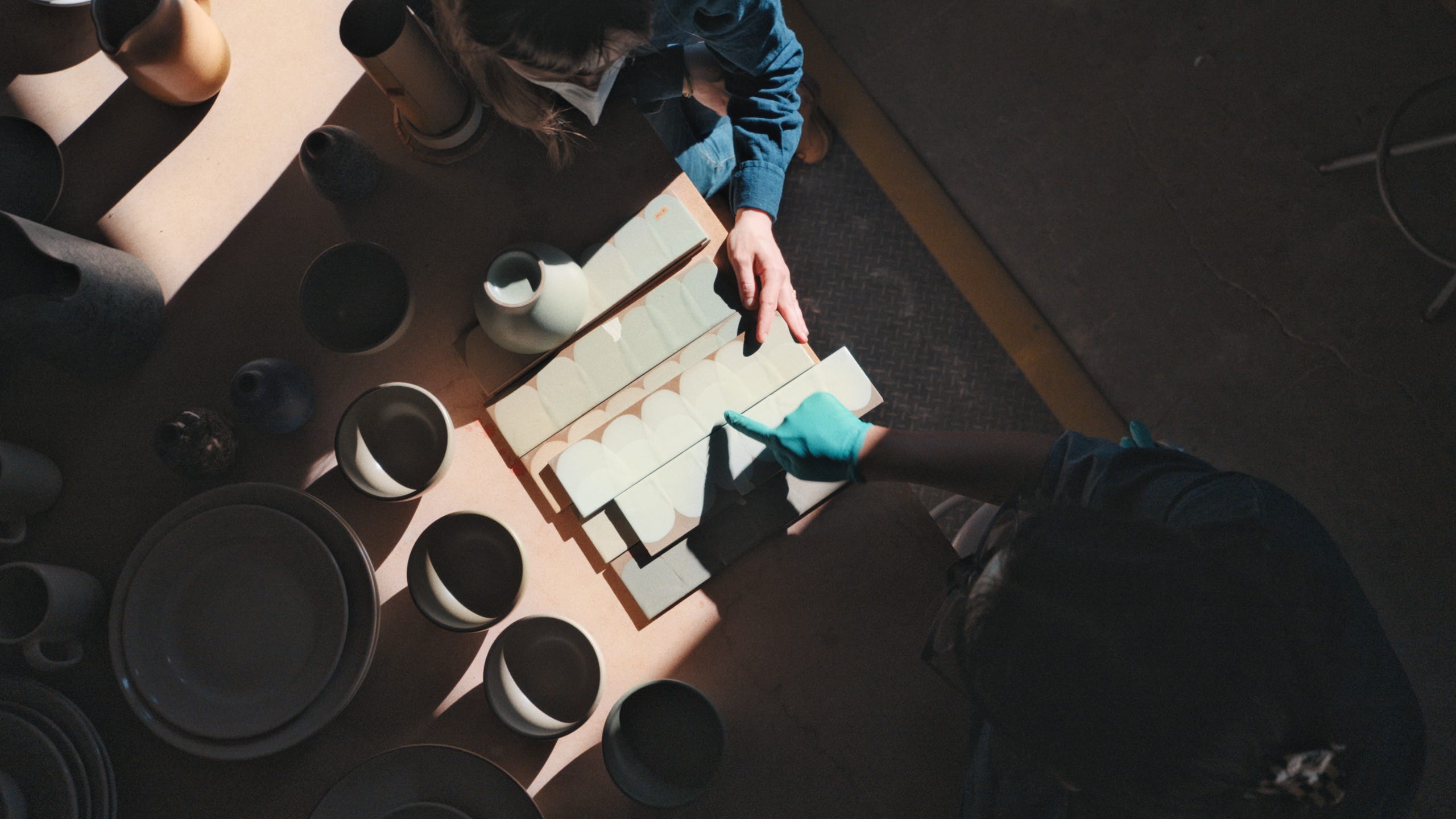
Cathy: You can’t put creativity in a spreadsheet. When someone at the top needs a risk-free decision, are they going to choose the creative, hard-to-articulate thing that feels right for the brand, or the chart that shows the money tripling?
Robin: And when design gets reduced to a marketing plan or a merchandising program as a stand-in for quantifying creativity—you get boring.
Cathy: When designers are talking ROI, something’s gone wrong.
Robin: Be conscious of it, yes—but it shouldn’t be driving your decisions.
Simone: And with a single person at the top, their voice becomes the loudest. Heath risks losing either the creativity or the operations.
Cathy: Creativity starts to serve the market instead of leading. You can still do good design in that context, but the magic doesn’t happen.
“You can’t put creativity in a spreadsheet.”
– Cathy Bailey
Robin: Operations needs to understand that part of its role is making space for creativity—that’s a stewardship function. Making sure creativity always has a place to come through.
Simone: A seat at the table. And to be clear: the reason this is formalized is that even after Megan and Allison, Heath will always be led by two people.
Cathy: It’s written into the Purpose Trust documents. We are required to uphold Two at the Top.
Simone: Let’s bring in Megan and Allison—our official Two at the Top. Megan Wernetti, President of Creative, and Allison Banks, President of Operations. How did each of you end up at Heath?
Megan: I’d worked for a restaurateur in Texas, making myself useful as projects evolved — architecture, interiors, branding, graphic design, managing events, doing the books. Then I moved to San Francisco and was looking at jobs in both graphic design and accounting on Craigslist. I came across Heath’s graphic designer posting. The job description started normally, then got weirder—jerseys for sports teams, working with people who spoke many different languages. It matched things I’d just done in Texas, and it just felt weirdly perfect.
Allison: My entire career before Heath was in HR in high tech—12 years at Perforce, then head of HR at GoPro through an IPO and opening seven international offices, then Mozilla, a mission-based software company. I needed a break from the pace of tech.
I did consulting and had a pickle business for a couple of years—selling at farmers markets, getting into Berkeley Bowl. But everywhere I turned, there was another problem, and eventually I gave up. Being at Heath is a little like that, except after 78 years, Heath never gives up.
Someone I’d worked with at GoPro had gone to design school with Robin and messaged me about the Head of People and Culture role. I’d always loved the brand. And when I read The Good Guide—a book about what makes Heath Heath—I got teary. It never occurred to me that a company like Heath would exist that I’d be able to work at.


Simone: What’s it like to be co-presidents?
Megan: I love it. We’ve worked together for a long time, so there’s a lot of implicit trust. Having someone to think through problems with—it illuminates things. We bring different strengths and expertise and are effective in our own areas, but we each have visibility into the other half of the business without being deeply embedded in it. That allows for fluency and agility.
Allison: I’ve worked with a lot of CEOs, and it’s really lonely being the only one at the top. I never wanted that job. Being in this Two at the Top role is the best of everything—I have my piece of the business, but I collaborate with someone who holds the other side. There’s nobody else I’d have wanted to do this with.
Megan: It’s so nice to have somebody to walk side by side with. Someone you trust, someone to share judgment calls with. It makes the work better—you’re not limited by your own biases or blind spots. We get more richness in every conversation.
“It makes the work better—you’re not limited by your own biases or blind spots.”
– Megan Wernetti, President of Creative
Simone: What’s the importance of this relationship for the company?
Allison: Different skill sets, different expertise — it makes everything richer. Megan sees things very differently from me. But where we’re congruent is work ethic, caring deeply, and caring about people. That filters down into the whole organization.
Simone: You both also get it done.
Allison & Megan: I think that’s the work ethic.
Allison: I couldn’t work with someone who didn’t have that.
Megan: I learn so much from Allison because she gets things done. It’s a high bar, and I feel honored to work beside her.
Simone: What does it mean to you to lead a company that has decided it will always be led by two people?
Megan: I think it’s great. I spend a lot of time thinking about Heath’s legacy—what it means to be design-led, to preserve a creative heart. It feels so essential to Heath’s DNA, and like something that has to be actively protected.
To see that defined in the leadership structure—that creative will always have a seat at the top and will always be represented by someone with that vision—is inspiring and comforting. It’s a real vote of confidence in what it takes to keep Heath Heath, ten, twenty, fifty years from now.
Simone: Why don’t more companies do this?
Allison: You have to check your ego at the door, and that’s hard for a lot of people. Collaborating takes longer. A lot of people want to make a decision, move on, and tell people what to do. It works with my style, but it’s not everyone’s.
Megan: It also works with Heath’s style. Heath does things the harder, slower way sometimes — not because hard and slow are inherently good, but because there are other aspects that come with it which are. We have a respect for all the good which can come out of collaboration, and a history that backs up its importance.
Simone: What would you want someone coming into this company to understand about why this structure exists?
Megan: We start all of our annual planning with the creative roadmap — every product launch, event, showroom update, anything the creative team will touch in the coming year.
Allison: We’re a design-led organization, so operations needs to support and understand that. Once we know the creative stakes in the ground, it becomes clear what operational work needs to happen to hold them up. No pedestal—it’s puzzle pieces fitting together.
“Once we have the creative stakes in the ground, it becomes clear what operational work needs to happen to hold them up. No pedestal—it’s puzzle pieces fitting together.”
– Allison Banks, President of Operations
Megan: Iteration is a core Heath value. There was one planning year where we didn’t lead with the creative roadmap, and everyone looked at each other, wondering where to start.
Pulling the creative roadmap forward enables us to say: here’s what we know to be important, here’s how we want to connect with customers. Once we know that, then we can plan what projects we need to do to make sure all of that can unfold as seamlessly as possible.
Simone: Some of this happened organically when Robin and Cathy were running things, because of their personal partnership. With new people, a new way of working had to be defined.
Megan: That was a real fear of mine in accepting the role. Cathy and Robin bring aspects of their personal relationship into the professional, not in a bad way—but you know they talk about work outside of work hours. Thinking about what success could look like in this position, when sharing it without someone I have dinner with, felt daunting. But whatever fears I had have really not come to pass. We’re figuring it out, and it’s been a really interesting journey.
Allison: I do feel like I’m in flow. It feels effortless, even though it’s not. It just feels right.
Megan: It’s a privilege to uphold even a small piece of its legacy.
Simone: Next episode: Under One Roof—how Heath designs, makes, sells, and ships under one proverbial roof.
Cathy: It’s quite unusual. Most companies try to focus on one thing. We’ve expanded and do it all. It’s complicated, but it makes us who we are.
Thanks for reading, listening, and for being here with us.
Want more Heath?
Cathy and Robin sat down with Dan Imhoff for the latest episode of his podcast, Full Expression. Each week, he explores what creativity is through deep conversations. Tune in here!